Best longevity peptides for beginners to start with.

See more of CureMed in your Google results.
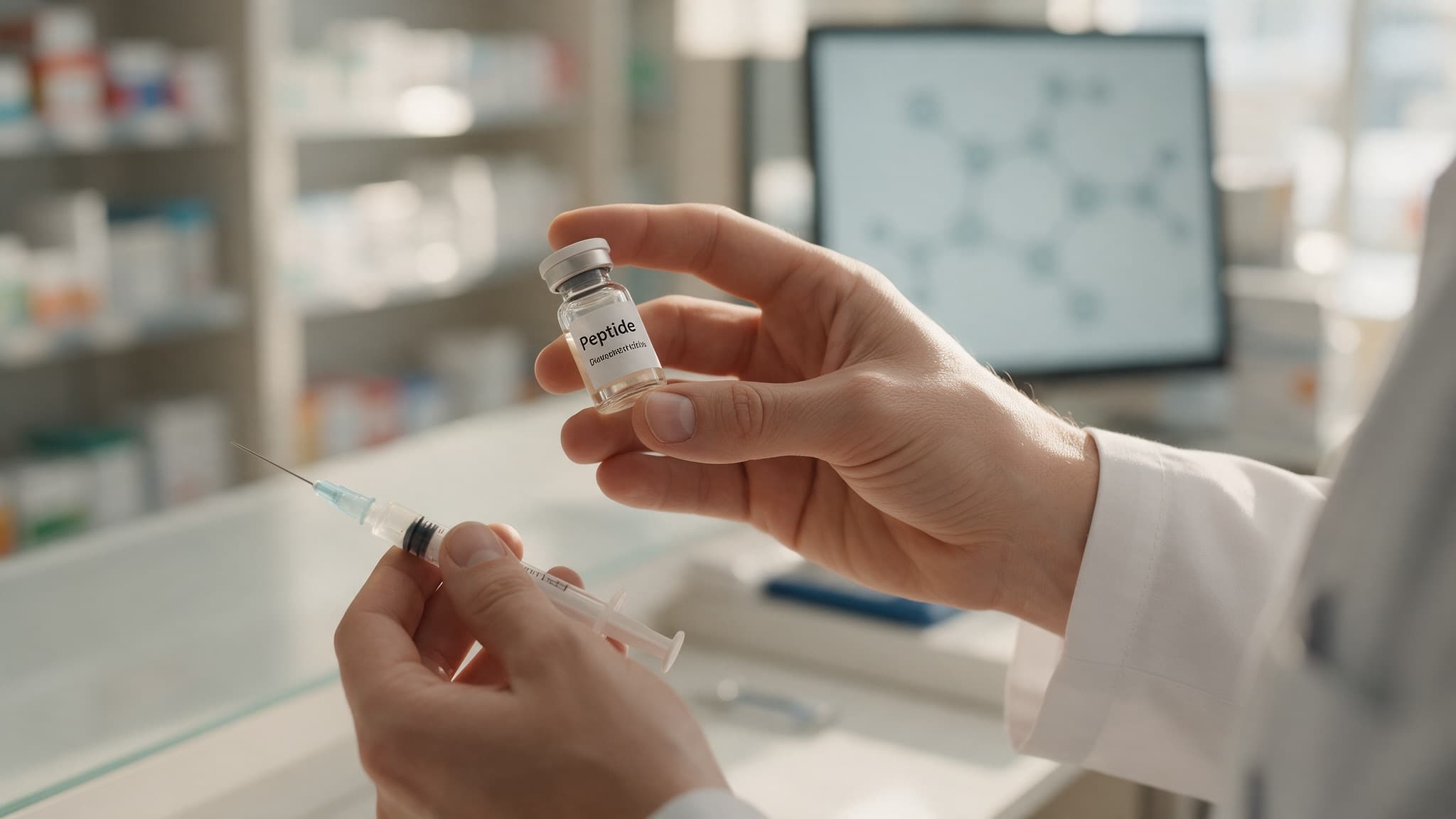
If you are new to peptides, start with the ones that are legal, studied in people and low-risk: a copper-peptide skin cream is the only true beginner option. Approved peptides like tesamorelin or sermorelin come next, but only through a doctor who has a real reason to prescribe them and checks your blood. The injectables sold to beginners online — BPC-157, TB-500 — have no human trials and unverified purity, and should be last, if ever. Get a blood panel and a pharmacist's check before anything.
The best peptide for a beginner is the one that is lawful to obtain, prescribed and monitored by a clinician, studied in humans, and low-risk by route — and ranked on those four tests the list runs: topical GHK-Cu first (over the counter, human skin trials, no injection, no systemic exposure); then an approved peptide through a prescriber if there is a genuine indication — tesamorelin for its approved use, PT-141 for its approved use, sermorelin where a clinician judges it appropriate — with baseline and follow-up blood tests; then nothing. The injectables beginners are usually sold first — BPC-157, TB-500, a CJC-1295/ipamorelin blend — rank last for a beginner specifically: no human trial, no lawful compounding route in most jurisdictions, unverified purity, an injection to learn, and no one monitoring the result. The honest beginner's stack is a skin cream, a blood panel and a conversation with a pharmacist; the honest beginner's longevity intervention is not a peptide.
- A beginner's first peptide should pass four tests in order: lawful, prescribed, human-studied, low-risk by route. Most of what is marketed to beginners fails all four.
- Topical GHK-Cu is the only peptide a beginner can start with no prescription, no injection and human evidence — for skin, which is what it does.
- Approved peptides are the right second step only with a genuine indication and a prescriber who runs baseline and follow-up tests.
- The 'beginner stack' sold online — BPC-157 plus TB-500 — combines two peptides with no human trial; it is a beginner stack because it is what vendors sell, not because it is safe to start with.
- Before any peptide: a medication review, because interactions with blood-pressure, glucose and thyroid medicines are screened by no vendor.
CureMed ranks on published human evidence, and screens drug interactions first.
Peptides for beginners, ranked
Ranked on: suitability as a first peptide: lawful to obtain through a quality-controlled route, prescribed and monitored, studied in humans, and low-risk by route of administration. Evidence of benefit is graded as on the compound pages; suitability for a beginner is the ordering.
| # | Option | Verdict | Grade |
|---|---|---|---|
| 1 | GHK-Cu, topical | The only genuine beginner peptide | GRADE CEarly |
| 2 | Tesamorelin, prescribed for its indication | Approved and monitored — if there is a reason | GRADE AEstablished |
| 3 | Sermorelin, prescribed and monitored | Known pharmacology, thin ageing evidence, lawful route | GRADE BPromising |
| 4 | PT-141 (bremelanotide), prescribed for its indication | Approved; not a longevity peptide | GRADE BPromising |
| 5 | Semax or selank, nasal | Low-risk route; no Western review; no lawful route in most places | GRADE CEarly |
| 6 | CJC-1295 / ipamorelin blends | Sold as the beginner anti-ageing stack; not for beginners | GRADE DInsufficient or unsafe |
| 7 | BPC-157 and TB-500, the 'healing stack' | The most-sold beginner stack; fails every test | GRADE DInsufficient or unsafe |
| 8 | Epitalon, MOTS-c, AOD-9604, melanotan II | No human data or documented harms; not a starting point | GRADE DInsufficient or unsafe |
Over the counter, applied to skin, with small human trials on skin appearance and wound healing and a long cosmetic safety record. No injection, no systemic exposure, no prescription, nothing to monitor. Grade C for evidence — a modest cosmetic effect — and first for a beginner because it passes every test. It is a skincare ingredient, and that is the honest scope of a beginner's peptide.
- 02
Tesamorelin, prescribed for its indication
GRADE AEstablishedApproved and monitored — if there is a reasonThe best-evidenced peptide on the site, approved for HIV-associated abdominal fat with Phase 3 safety data. A beginner's route to it is a prescriber with a genuine indication and baseline glucose and IGF-1 tests. Off-label anti-ageing prescribing exists; the evidence for it does not. Ranked second because the lawful, monitored path exists and most beginners do not have the indication.
- 03
Sermorelin, prescribed and monitored
GRADE BPromisingKnown pharmacology, thin ageing evidence, lawful routeAn approved diagnostic agent with a long safety record, prescribed off-label by some clinicians for growth-hormone support. If a beginner is going to use a growth-hormone-axis peptide at all, this is the one with a prescription route, a known profile and a clinician to monitor IGF-1. The ageing benefit is unproven; the monitoring is the point.
- 04
PT-141 (bremelanotide), prescribed for its indication
GRADE BPromisingApproved; not a longevity peptideApproved for hypoactive sexual desire disorder in premenopausal women, with known side effects including a transient blood-pressure rise. It is on beginner lists because it is sold alongside the others; it has no longevity claim and belongs on this page only as an example of what an approved, prescribed peptide looks like.
- 05
Semax or selank, nasal
GRADE CEarlyLow-risk route; no Western review; no lawful route in most placesNasal peptides with decades of Russian prescription use for cognition and anxiety, and no Western regulatory review. The route is benign; the sourcing is grey-market outside Russia and the evidence is unexamined. Fails the lawful-route test in most jurisdictions.
- 06
CJC-1295 / ipamorelin blends
GRADE DInsufficient or unsafeSold as the beginner anti-ageing stack; not for beginnersRaise GH and IGF-1 — an axis a beginner has never had measured — with regulatory citations of vasodilatory reactions and serious adverse events, no lawful compounding route from bulk in the US, and no ageing benefit shown against placebo. The worst combination for a first peptide: systemic hormonal effect, no monitoring, unverified vial.
- 07
BPC-157 and TB-500, the 'healing stack'
GRADE DInsufficient or unsafeThe most-sold beginner stack; fails every testTwo injectables with no completed human trial, no lawful compounding route in most jurisdictions, unverified purity and dose, and an injection technique to learn unsupervised. They are a beginner stack because vendors sell them to beginners. On the four tests they rank last.
- 08
Epitalon, MOTS-c, AOD-9604, melanotan II
GRADE DInsufficient or unsafeNo human data or documented harms; not a starting pointUnreplicated, untested, failed in trial, or harmful respectively. None is a beginner's peptide or, on the evidence, anyone's.
What to do before any peptide
The beginner's sequence
| Step | What | Why it comes before the peptide |
|---|---|---|
| 1 | A medication and supplement review with a pharmacist | Growth-hormone peptides affect glucose and fluid; PT-141 raises blood pressure; nobody else screens the interactions |
| 2 | A baseline blood panel: fasting glucose and HbA1c, IGF-1, lipids, liver and kidney function, blood pressure | Without a baseline there is no way to know what a peptide did |
| 3 | A clear question the peptide is supposed to answer | 'Longevity' is not an indication; abdominal fat, a skin concern, a diagnosed deficiency are |
| 4 | A lawful route: prescription, pharmacy, cosmetic product | A vial from a research-chemical vendor has no quality control and no one accountable |
| 5 | The lowest-risk route that answers the question | Topical before nasal before injectable; approved before compounded before grey-market |
| 6 | A follow-up test at eight to twelve weeks | The only way to know whether to continue |
Frequently asked questions
What is the best peptide for a beginner?
Topical GHK-Cu: over the counter, applied to skin, with human trials on skin appearance and a long safety record — no injection, no prescription, nothing to monitor. It is a skincare ingredient, and that is the honest scope of a first peptide. Approved peptides like tesamorelin or sermorelin are the next step only through a prescriber with a genuine indication and baseline blood tests. The injectables sold to beginners online rank last.
Is BPC-157 a good peptide to start with?
No. It has no completed human trial, no lawful compounding route from bulk in the US, unverified purity and dose from research-chemical vendors, and requires an unsupervised injection. It is sold as a beginner peptide because it is easy to sell, not because it is appropriate to start with. On the four tests a first peptide should pass — lawful, prescribed, human-studied, low-risk route — it fails all four.
Should a beginner use a CJC-1295 and ipamorelin blend?
It is the worst fit for a first peptide: it raises growth hormone and IGF-1 — an axis a beginner has never had measured — with regulatory citations of adverse reactions, no lawful compounding route, no ageing benefit shown against placebo, and no monitoring. If a growth-hormone-axis peptide is going to be used at all, sermorelin through a prescriber who checks IGF-1 is the version with a lawful route and a known profile.
What tests should I get before starting peptides?
A medication and supplement review with a pharmacist first, then a baseline panel: fasting glucose and HbA1c, IGF-1, lipids, liver and kidney function, and blood pressure. Growth-hormone peptides affect glucose and fluid balance; PT-141 raises blood pressure. Without a baseline there is no way to know what a peptide did, and a follow-up at eight to twelve weeks is the only way to decide whether to continue.
Can a beginner get peptides legally?
Topical GHK-Cu is a cosmetic product available anywhere. Tesamorelin, sermorelin and PT-141 are approved medicines available by prescription for their indications. Most peptides sold for longevity — BPC-157, TB-500, CJC-1295, ipamorelin, epitalon, MOTS-c — have no lawful route to be compounded from bulk in the US and are sold as 'research chemicals' outside pharmaceutical quality control. Rules differ by country; the absence of a lawful route is a safety signal in itself.
Is any peptide a good starting point for longevity?
For longevity specifically, no peptide has human evidence of extending life or slowing ageing. The interventions with outcome trials — resistance training, blood-pressure and lipid control, not smoking, sleep — are the beginner's longevity stack. A peptide can be a reasonable choice for a specific concern with an approved product and a prescriber; it is not where longevity starts.
Keep reading
- What are the safest and best longevity peptides?
The full safety ranking with regulatory status.
- Peptide therapy at longevity clinics
What a prescribed, monitored peptide route looks like — and what clinics cannot lawfully compound.
- Best longevity skincare routine to slow visible aging
Where GHK-Cu sits in a routine with retinoids and sunscreen.
- Free stack check
The medication screen that comes before any peptide.
More in Peptides
- Best longevity peptides for skin health and wrinkle reduction.
Matrixyl has the largest placebo-controlled trial (93 women, 12 weeks); copper peptide has thinner proof. Both rank below sunscreen and retinoids.
- Peptides and therapies commonly used to extend lifespan.
GLP-1 peptides rank highest for longevity, backed by outcome trials — growth hormone peptides, BPC-157, and NAD+ infusions rank far lower on human evidence.
- Which longevity peptides are best for energy and recovery?
BPC-157, TB-500, MOTS-c, CJC-1295, ipamorelin, sermorelin and tesamorelin ranked on human trials for energy and recovery — most have none in humans.
- What are the safest and best longevity peptides?
Approved peptides tesamorelin and PT-141 rank safest with Phase 3 trial data; unregulated injectables like BPC-157 and TB-500 have no human trials at all.
- Best longevity peptides for anti-aging and cellular repair.
GHK-Cu applied to skin is the only peptide with a measured repair effect in human trials; every other anti-ageing peptide has just animal or cell data.
- Which longevity peptides work best for lifespan extension?
No longevity peptide has human lifespan-extension evidence; ranked on animal data for epitalon, MOTS-c, SS-31, humanin and the GH-axis peptides.