GHK-Cu: evidence, dosing, safety & interactions
Glycyl-L-histidyl-L-lysine-copper(II) complex
Also sold or labeled as: Copper tripeptide-1, Copper peptide, GHK-copper, CU100
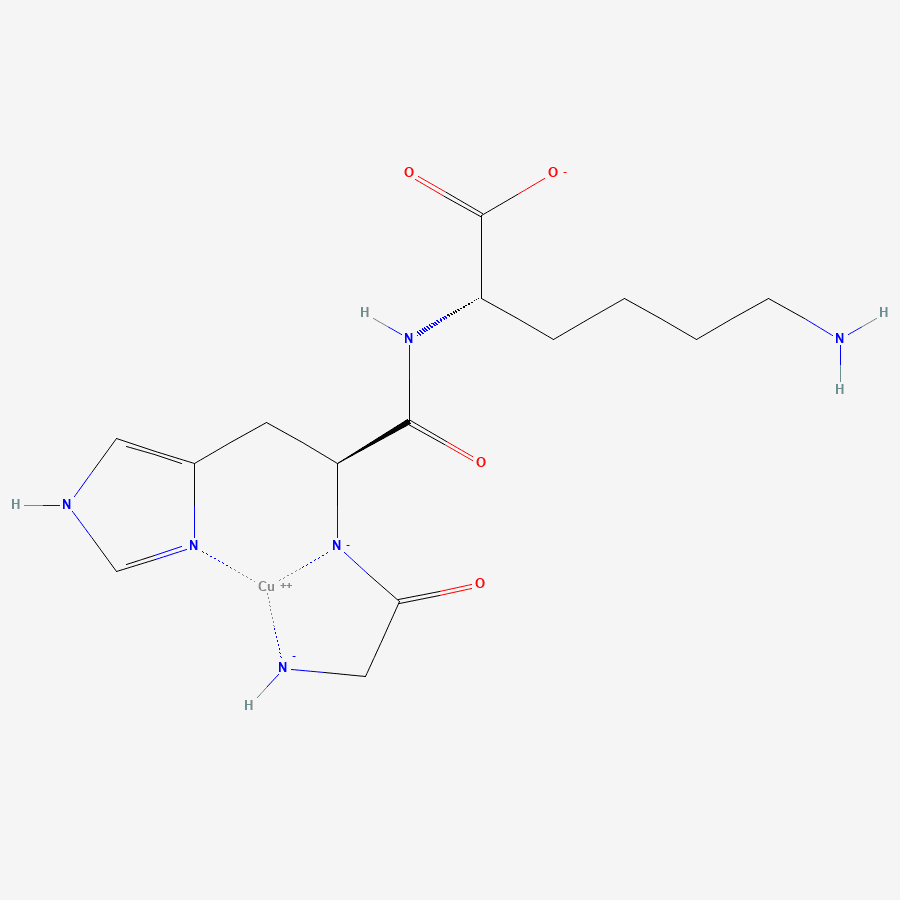
This is a natural substance your body already makes, used in skincare creams to help skin look and heal better. There's decent evidence it helps skin — but it's a cosmetic ingredient, not a medicine.
- What it is
- A copper-binding tripeptide, naturally present in the body, formulated into topical skincare products — not an injectable therapeutic peptide.
- Evidence
- One small randomized trial in post-laser skin found no objective difference in wrinkles or redness resolution, but a significant improvement in patient-reported satisfaction.
- Studied dose
- A topical copper tripeptide skincare regimen applied after laser resurfacing — there is no established systemic or injectable human dose.
- Safety
- Well tolerated as a topical ingredient in the published trial. Injectable or systemic use has no human safety data at all.
What human trials actually show
Randomized, placebo-controlled human trials only. Animal data never appears in this section — it cannot raise a grade, and it is noted separately below.
- 01Archives of Facial Plastic Surgery2006— Skin appearance after CO2 laser resurfacing
- Design
- Randomized, controlled
- Dose
- Topical copper tripeptide complex (GHK-Cu) skincare regimen versus a regimen without it, post-treatment
- Duration
- 12 weeks of post-treatment follow-up
13 patients who completed treatment, following circumoral CO2 laser skin resurfacing
Computer analysis and blinded evaluators found no statistically significant difference between groups in earlier resolution of erythema (redness), and no significant objective improvement in wrinkles or overall skin quality. However, patient-reported satisfaction with overall skin quality was significantly higher in the group using GHK-Cu (p=.04).
doi:10.1001/archfaci.8.4.252
This is a single trial of 13 patients, using a topical cosmetic regimen after laser resurfacing — not a study of GHK-Cu as a standalone systemic or longevity intervention. Its own objective measures (computer-analysed redness, blinded evaluator ratings of wrinkles) found no significant benefit; only the subjective patient-satisfaction score reached significance, and subjective satisfaction can be influenced by expectation as much as by the ingredient. No controlled human trial has tested GHK-Cu injected or taken systemically, and none has measured any longevity or healthspan outcome. The animal and cell-culture work on GHK-Cu's wound-healing and gene-regulatory effects is more extensive than the human data, but it has not translated into a positive controlled human trial beyond this one cosmetic study.
Grade C — early. The one controlled human trial found no objective improvement in skin appearance — only a subjective patient-satisfaction difference. Despite its peptide-therapy branding, GHK-Cu's evidence base is topical cosmetic dermatology, not systemic anti-aging. How we grade evidence.
Side effects & safety
- Reported topically
- Generally well tolerated as a skincare ingredient in the published trial, with no reported irritation attributed specifically to GHK-Cu beyond what the laser procedure itself caused.
- Injectable or systemic use
- No controlled human safety data exists for injectable or oral GHK-Cu. Products marketed for injection are not approved pharmaceutical formulations in any market covered here.
- The honest caveat
- GHK-Cu is often mentioned alongside injectable peptides like BPC-157, which creates an impression of a similar evidence class. It is not — the actual human trial behind it is a small cosmetic-dermatology study with a null objective result.
Interactions with medications
The section most longevity sites skip. If you take prescription medication, read this before anything else on the page.
Commonly layered together in skincare routines. No controlled trial has tested the combination specifically, and no safety concern has been reported, but effectiveness claims for combining them are anecdotal.
The one positive trial applied it specifically after laser resurfacing under medical supervision. Applying any active skincare ingredient to compromised skin outside that supervised context carries a higher irritation risk.
No human data on interactions, dosing, or safety exists for non-topical use. There is no established route by which GHK-Cu is a systemic therapeutic, and no approved injectable product.
Is GHK-Cu legal where you live?
Regulatory status is tracked per market and reviewed on the date shown. Where a compound is not authorised, this site does not link to sellers.
Sold freely as a cosmetic ingredient in skincare products, regulated as a cosmetic rather than a drug. This site does not sell or take affiliate revenue on GHK-Cu products.
Source: US Food and Drug Administration
Sold as a cosmetic ingredient under UK cosmetic-product regulation, with no prescription required for topical use.
Source: Office for Product Safety and Standards
Sold as a cosmetic ingredient under EU cosmetics regulation. No prescription is required for topical skincare use.
Source: European Commission
Vendu comme ingrédient cosmétique conformément à la réglementation européenne sur les cosmétiques, sans ordonnance pour un usage topique.
Source: Commission européenne / ANSM
Se vende como ingrediente cosmético conforme a la normativa europea de cosméticos, sin necesidad de receta para uso tópico.
Source: Comisión Europea / AEMPS
Wird als kosmetischer Inhaltsstoff gemäß der EU-Kosmetikverordnung verkauft, ohne Rezeptpflicht für die topische Anwendung.
Source: Europäische Kommission / BfArM
Sold freely as a cosmetic skincare ingredient (copper peptide serums) through mainstream UAE retailers including Amazon.ae and noon.com, consistent with its regulation as a cosmetic rather than a drug. This site does not sell or take affiliate revenue on GHK-Cu products in any market.
Source: UAE Ministry of Health and Prevention (MOHAP) — cosmetics
A third-party peptide-legal-status tracker (peptide.law) lists GHK-Cu as one of a small number of peptides it classes as legal to buy in Saudi Arabia, consistent with its treatment elsewhere as a cosmetic ingredient rather than a therapeutic peptide. We could not independently verify this against a primary SFDA cosmetics listing.
Source: Saudi Food and Drug Authority (SFDA) — cosmetics
Venduto liberamente come ingrediente cosmetico ai sensi del regolamento UE sui cosmetici (CE) n. 1223/2009, senza necessità di ricetta per l'uso topico. Non abbiamo trovato alcuna norma italiana specifica che differisca dal quadro UE. Questo sito non vende né riceve commissioni su prodotti a base di GHK-Cu in nessun mercato.
Source: Ministero della Salute / Commissione europea — cosmetici
Vrij verkrijgbaar als cosmetisch ingrediënt onder de EU-cosmeticaverordening (EG) nr. 1223/2009, zonder recept voor topisch gebruik. We vonden geen Nederlandse regel die afwijkt van het EU-kader. Deze site verkoopt geen GHK-Cu-producten en ontvangt daar in geen enkele markt commissie op.
Source: NVWA / Europese Commissie — cosmetica
Como ingrediente cosmético de uso tópico (cremes e séruns), segue as regras normais de regularização de cosméticos da Anvisa, sem exigir registro como medicamento. A forma injetável é outra história: a Anvisa nomeou publicamente o GHK-Cu entre os peptídeos vendidos online sem registro em nenhuma categoria, alertando que a via injetável não é aprovada nem regularizada. Este site não vende nem recebe comissão por produtos com GHK-Cu em nenhum mercado.
Source: Agência Nacional de Vigilância Sanitária (ANVISA)
Dosing & timing
The published trial applied a copper tripeptide-containing skincare regimen after laser resurfacing, following the product's standard topical application schedule — not a measured milligram dose.
No human trial has determined a safe or effective systemic or injectable dose. Anything sold for injection is outside the evidence base described here.
The only positive human data concerns topical cosmetic formulations, consistent with how it is legally sold in every market this site covers.
Questions people actually ask
Does GHK-Cu really work as an anti-aging ingredient?
The one controlled human trial found no objective improvement in wrinkles or skin quality — only a significantly higher patient-satisfaction score. That is a real but modest and subjective result, not evidence of a measurable anti-aging effect.
Is GHK-Cu the same kind of peptide as BPC-157?
They are both short peptides, but the comparison stops there. GHK-Cu is a legal, widely sold cosmetic ingredient with one small topical human trial behind it. BPC-157 is an unapproved injectable with essentially no controlled human data. Treating them as the same evidence category is a mistake.
Can I inject GHK-Cu?
There is no human safety or efficacy data for injectable or systemic GHK-Cu, and no approved injectable formulation exists in any market covered here. The evidence that exists is for topical cosmetic use only.
Is GHK-Cu safe to use on skin?
It appears well tolerated as a topical ingredient in the one published trial, applied under medical supervision after a laser procedure. General cosmetic use in over-the-counter products has not raised particular safety concerns, but formal long-term topical safety trials are limited.
Why is GHK-Cu marketed as a peptide therapy for longevity?
Because it is a naturally occurring peptide that declines with age, which makes for an appealing longevity narrative. The actual controlled evidence behind it is a small cosmetic-dermatology trial with a null objective result — a long way from a systemic anti-aging therapy.