SS-31 (Elamipretide): evidencia, dosificación, seguridad e interacciones
Elamipretide, a cell-permeable, cardiolipin-binding tetrapeptide (D-Arg-2',6'-dimethylTyr-Lys-Phe-NH2)
También vendido o etiquetado como: SS-31, Elamipretide, Bendavia, MTP-131, 2S10
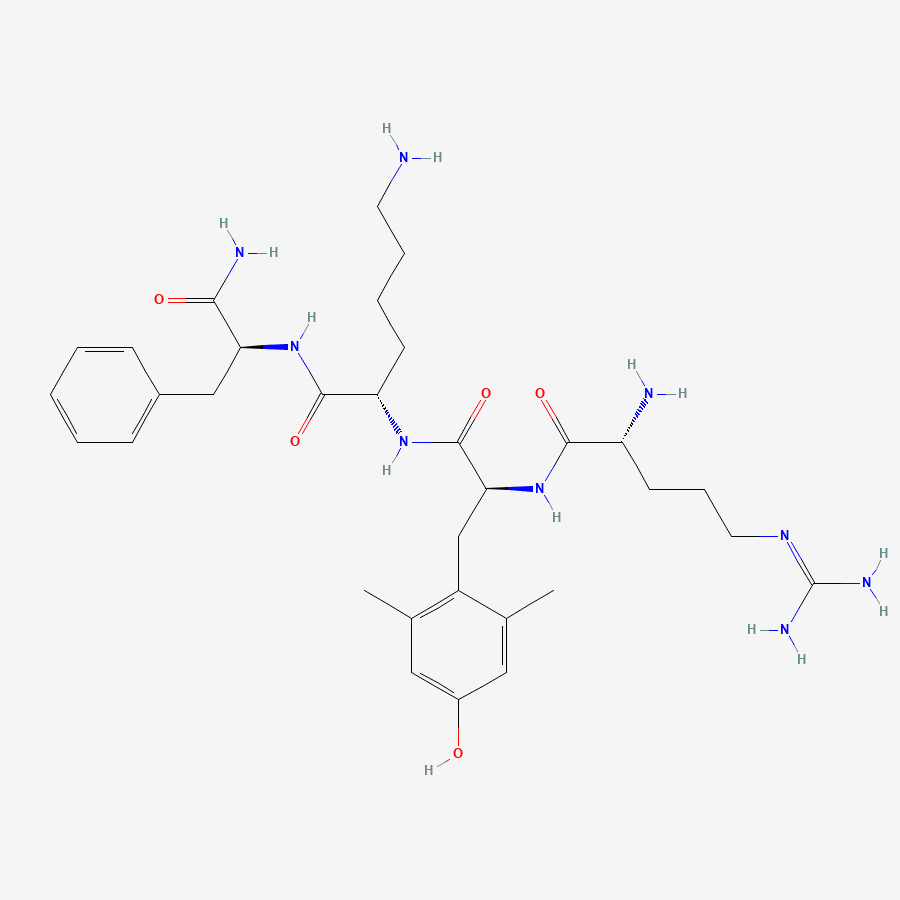
This is a real pharmaceutical-grade compound that a drug company tested properly in large human trials for a genetic muscle disease — and the biggest, most rigorous trial found it didn't actually help patients walk further or feel less tired. A separate small study found it improves a lab measure of muscle energy production in healthy older adults, which is a real but much narrower finding than 'proven to fight aging.'
- What it is
- A purpose-built pharmaceutical compound (not a repurposed research curiosity) that reached a real Phase 3 human trial for a genetic mitochondrial muscle disease.
- Evidence
- The pivotal Phase 3 trial (218 patients) failed its primary endpoints. A separate small trial in 39 healthy older adults found a positive effect on a mitochondrial energy biomarker, not a clinical outcome.
- Studied dose
- 40 mg/day subcutaneous in the mitochondrial myopathy trials (4-24 weeks); a single dose in the healthy-older-adult biomarker study.
- Safety
- Consistently well tolerated across every published human trial, with mostly mild-to-moderate adverse events — genuinely one of the better safety records among peptides covered on this site, even though the efficacy case for its main studied use did not pan out.
Lo que realmente muestran los ensayos en humanos
Solo ensayos aleatorizados y controlados con placebo en humanos. Los datos en animales nunca aparecen en esta sección: no pueden elevar una calificación y se indican por separado más abajo.
- 01Neurology2023— Phase 3 efficacy and safety trial in primary mitochondrial myopathy (MMPOWER-3)
- Diseño
- Randomised, double-blind, placebo-controlled, parallel-group Phase 3 trial
- Dosis
- 40 mg/day subcutaneous elamipretide vs. placebo
- Duración
- 24 weeks
218 adults with genetically confirmed primary mitochondrial myopathy
Did not meet either primary endpoint: the 6-minute walk test difference vs. placebo was -3.2 m (95% CI -18.7 to 12.3, p=0.69), and the fatigue score difference was not significant (p=0.37). The authors state this is Class I evidence that elamipretide does not improve walk distance or fatigue in this population. Treatment was well tolerated.
doi:10.1212/WNL.0000000000207402 - 02Journal of Cachexia, Sarcopenia and Muscle2020— Phase 2 crossover trial in primary mitochondrial myopathy (MMPOWER-2)
- Diseño
- Randomised, double-blind, placebo-controlled crossover trial
- Dosis
- 40 mg/day subcutaneous elamipretide for 4 weeks vs. placebo for 4 weeks (crossover, with washout)
- Duración
- 4 weeks per arm
30 adults with genetically confirmed primary mitochondrial myopathy
A numerically longer 6-minute walk distance with elamipretide (398.3 m) than placebo (378.5 m), a 19.8 m difference whose confidence interval crossed zero — directionally positive but not a clear, statistically robust effect, and this smaller signal did not hold up in the larger MMPOWER-3 trial that followed it.
doi:10.1002/jcsm.12559 - 03PLoS ONE2021— Single-dose effect on mitochondrial ATP production in healthy older adults
- Diseño
- Randomised, double-blind, placebo-controlled trial
- Dosis
- A single dose of elamipretide, measured against placebo
- Duración
- Acute, single-dose measurement using MRI/MRS of the first dorsal interosseous muscle
39 healthy older adults (60-85 years) selected for reduced mitochondrial function
A single dose improved in vivo mitochondrial ATP production capacity (ATPmax) and mitochondrial coupling efficiency compared with placebo — a genuine, well-measured positive effect on a mitochondrial energy biomarker in ageing muscle, though this is a lab measurement, not a functional or clinical outcome.
doi:10.1371/journal.pone.0253849
The central fact here is a real Phase 3 trial that failed: in the population elamipretide was specifically developed to treat, at the dose the developer chose after Phase 2 work, it did not improve walk distance or fatigue versus placebo. That is a much stronger and more specific piece of negative evidence than most peptides on this site have generated in either direction. The one clearly positive human finding — improved mitochondrial ATP production after a single dose in healthy older adults — has not been followed by any published trial testing whether that biomarker change translates into something a person experiences (strength, fatigue, function) over a realistic treatment duration. There is no human evidence at all for the general 'anti-aging' or performance claims the compound is marketed on to consumers under the code name SS-31.
Grade C — temprano. SS-31/elamipretide is one of the only compounds on this site's peptides hub with an actual completed Phase 3, randomised, double-blind, placebo-controlled trial (MMPOWER-3, N=218, NCT03323749) run by its developer for a real diagnosed condition (primary mitochondrial myopathy). That trial is Class I evidence that elamipretide did NOT improve either primary endpoint — 6-minute walk distance or patient-reported fatigue — versus placebo at 24 weeks. A separate, smaller randomised trial in 39 healthy older adults did find that a single dose improved a direct biomarker of mitochondrial energy production (ATPmax) measured by MRI/MRS. This lands at Grade C rather than D because the biomarker effect in aging muscle is a genuine, well-measured, positive human finding — but it lands well below B or A because the compound's own flagship outcome trial, in the population it was actually developed to treat, failed. The safety profile across all these trials has been good; the efficacy case for the disease claim it was built on has not held up. Cómo calificamos la evidencia.
Efectos secundarios y seguridad
- Reported across the human trials
- Consistently well tolerated in the mitochondrial myopathy trials and the healthy-older-adult biomarker study, with adverse events reported as mild to moderate. This is a genuinely better-documented safety record than most peptides covered on this site.
- The honest caveat
- Good tolerability in a monitored trial, at a company-controlled dose and formulation, does not carry over automatically to an unregulated 'research use only' vial of unknown purity self-administered without medical supervision.
Interacciones con medicamentos
La sección que la mayoría de los sitios de longevidad se saltan. Si toma medicamentos con receta, lea esto antes que cualquier otra cosa en esta página.
No formal drug-interaction studies were located outside the sponsor's own clinical trial programme.
¿Es legal SS-31 (Elamipretide) donde vives?
El estatus regulatorio se rastrea por mercado y se revisa en la fecha indicada. Cuando un compuesto no está autorizado, este sitio no enlaza a vendedores.
Its pivotal Phase 3 trial did not meet primary endpoints, and it is not an FDA-approved drug for any indication. Not lawfully marketed as a dietary supplement.
Fuente: US Food and Drug Administration
No UK marketing authorisation as a medicine and no permitted route to sell it as a food supplement.
Fuente: MHRA
No EU marketing authorisation and no novel-food authorisation.
Fuente: European Medicines Agency
Germany applies the EU position: no authorised medicinal product and no permitted supplement use.
Fuente: BfArM / European Medicines Agency
Aucune autorisation de mise sur le marché et aucun statut de nouvel aliment.
Fuente: European Commission / ANSM
Sin autorización de comercialización ni condición de nuevo alimento.
Fuente: European Commission / AEMPS
Dosificación y momento de la toma
This is the dose the drug's own developer settled on for its outcome trial, in a supervised clinical setting, and it still did not beat placebo on the trial's primary endpoints.
No trial supports a specific dose or duration for the general use this compound is actually sold for.
Preguntas que la gente realmente hace
Does SS-31 / elamipretide actually work?
For the specific condition it was developed to treat (primary mitochondrial myopathy), the pivotal Phase 3 trial found it did not improve walking distance or fatigue versus placebo — a clear negative result from a well-designed study. A separate small trial found it improves a mitochondrial energy biomarker in healthy older adults after a single dose, which is real but far narrower than a proven anti-aging or performance benefit.
Why does this compound have so much more human trial data than most research peptides?
It was developed as an actual drug candidate by a pharmaceutical company (Stealth BioTherapeutics), which ran it through the normal regulated trial pipeline — Phase 1 safety, Phase 2 dose-finding, and a pivotal Phase 3 efficacy trial. Most peptides sold as 'research chemicals' have never gone through that process at all.
Is SS-31 approved as a drug?
No. Its pivotal Phase 3 trial in primary mitochondrial myopathy did not meet its primary endpoints, and it is not an FDA-approved medicine for that or any other indication. It is not lawfully marketed as a dietary supplement either.
Is it safe to inject SS-31 bought online?
The compound has a genuinely good safety record across its published clinical trials, which is unusual and worth noting. But that record comes from a company-controlled formulation and dose under medical monitoring — it does not transfer automatically to an unregulated vial of unknown purity, self-administered without supervision.