Best regenerative medicine options for tendon and ligament injuries.

See more of CureMed in your Google results.
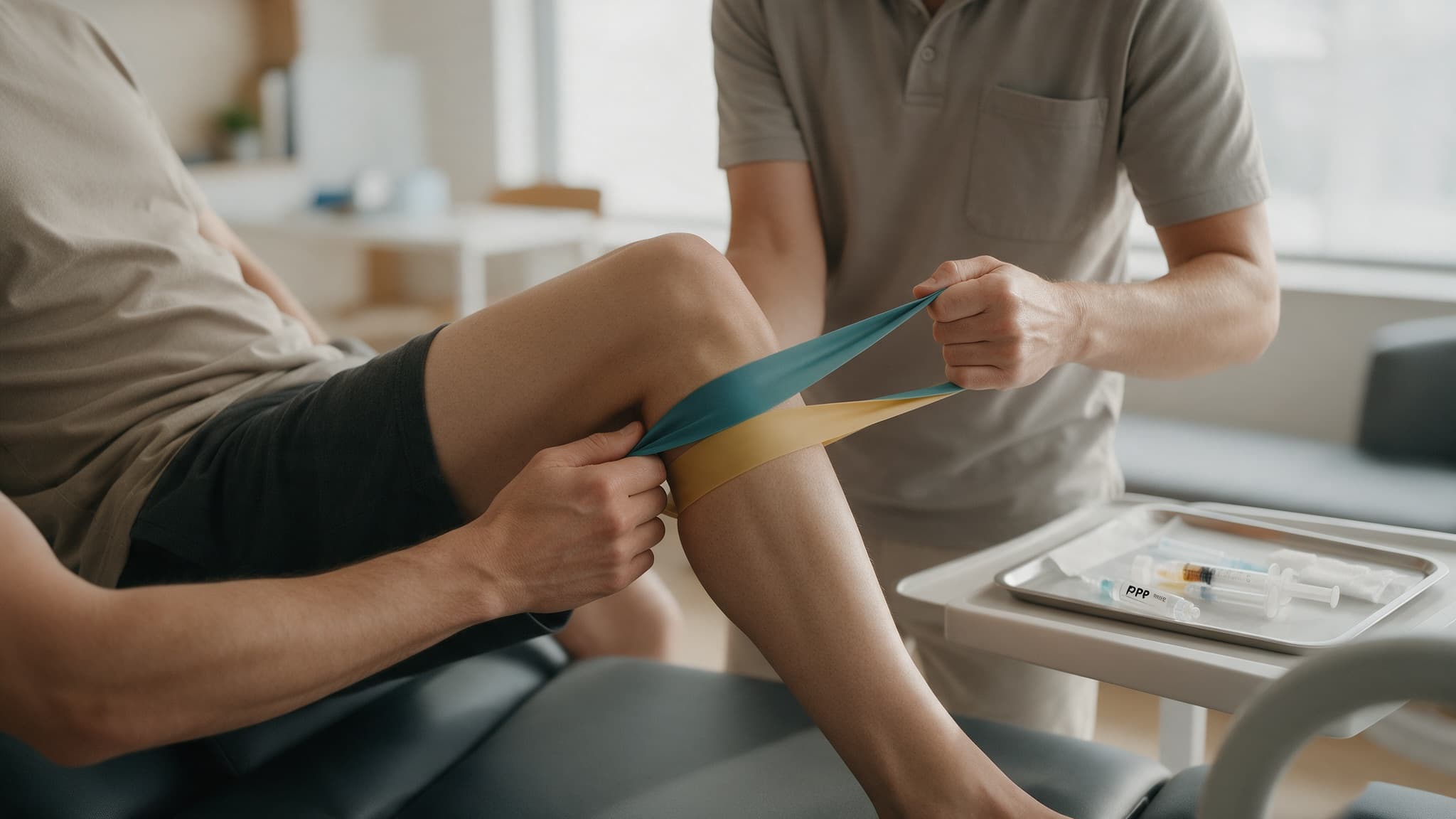
Tendons and ligaments heal through a carefully increased loading programme — that is the treatment with the best evidence, and injections are add-ons at most. PRP genuinely helps tennis elbow and probably the patellar tendon, did no better than placebo for the Achilles, and is hit-and-miss in the shoulder. Steroid injections relieve tendon pain briefly and leave it worse a year later. Shockwave helps some tendons. Ligaments are rehabilitated and, if unstable, reconstructed. Stem-cell and exosome injections have no evidence for any tendon.
For tendon and ligament injuries the best-evidenced treatment is progressive loading — eccentric and heavy slow resistance exercise — which outperforms every injection in the tendinopathies that have been trialled, and the regenerative options rank by tendon rather than by product: PRP has reasonable randomised evidence in chronic lateral epicondylitis (tennis elbow) and some in patellar tendinopathy, was no better than placebo in a well-run Achilles tendinopathy trial, and has inconsistent results in rotator cuff disease; corticosteroid injections relieve tendon pain for weeks and produce worse outcomes at a year than doing nothing; shockwave therapy has modest evidence in calcific shoulder, plantar fascia and some insertional tendinopathies; needle tenotomy is low-risk with small trials; surgery is for ruptures and for recalcitrant cases after loading fails. For ligaments, rehabilitation is the treatment, reconstruction is for instability, and PRP adds nothing in trials of the anterior cruciate ligament. Stem-cell injections have no controlled evidence in any tendon or ligament and exosomes none at all. Load the tendon, be patient, use PRP where the trials say it helps, and refuse the steroid unless the plan is a short bridge.
- Tendons adapt to load; a loading programme is the treatment and everything injected is at best an adjunct to it.
- PRP is not one answer: it has trial support in tennis elbow and the patellar tendon, failed against placebo in the Achilles, and is inconsistent in the shoulder.
- A steroid injection into a tendon buys weeks and costs the year — the trials are consistent on this.
- Ligaments are rehabilitated, not regenerated; PRP added nothing in ACL trials.
- No stem-cell or exosome product has controlled evidence in any tendon or ligament.
Graded by CureMed against human clinical evidence, and reviewed by CureMed Labs.
Tendon and ligament treatments, ranked
Ranked on: randomised evidence for pain and function in the specific tendon or ligament the treatment is offered for, weighted by durability and safety. Where a treatment's evidence differs by tendon, the tendons are named; a treatment with no controlled evidence in any tendon cannot rank above D.
| # | Option | Verdict | Grade |
|---|---|---|---|
| 1 | Progressive loading — eccentric and heavy slow resistance exercise | The treatment; outperforms injections in every tendinopathy trialled | GRADE AEstablished |
| 2 | PRP — chronic lateral epicondylitis (tennis elbow) | The tendon where PRP has its best evidence | GRADE BPromising |
| 3 | PRP — patellar tendinopathy | Some randomised support as an adjunct to loading | GRADE CEarly |
| 4 | Shockwave therapy — calcific rotator cuff, plantar fascia, insertional tendinopathies | Modest evidence where it has been trialled | GRADE CEarly |
| 5 | Needle tenotomy or dry needling | Low risk; small trials; often the active comparator PRP has to beat | GRADE CEarly |
| 6 | PRP — Achilles tendinopathy | No better than placebo in a well-run trial | GRADE DInsufficient or unsafe |
| 7 | PRP — rotator cuff tendinopathy and repair | Inconsistent; no clear benefit | GRADE CEarly |
| 8 | Corticosteroid injection — any tendon | Weeks of relief; worse outcomes at a year | GRADE DInsufficient or unsafe |
| 9 | Surgery — ruptures; recalcitrant tendinopathy after loading fails | For the right indication, with rehabilitation | GRADE BPromising |
| 10 | Ligament injury — rehabilitation, reconstruction for instability; PRP adds nothing | Rehab is the treatment; PRP failed in ACL trials | GRADE AEstablished |
| 11 | Stem-cell injections — any tendon or ligament | No controlled evidence; not approved | GRADE DInsufficient or unsafe |
| 12 | Exosomes and 'IV stem cells' for tendons | No evidence; regulator warnings | GRADE DInsufficient or unsafe |
- 01
Progressive loading — eccentric and heavy slow resistance exercise
GRADE AEstablishedThe treatment; outperforms injections in every tendinopathy trialledStructured, progressively loaded exercise improves pain and function in Achilles, patellar, lateral elbow, gluteal and rotator cuff tendinopathy across randomised trials, with effects that build over three to six months and persist. Heavy slow resistance matches eccentric loading with better adherence. Slow, unglamorous and the only thing that changes the tendon.
- 02
PRP — chronic lateral epicondylitis (tennis elbow)
GRADE BPromisingThe tendon where PRP has its best evidenceRandomised trials show PRP outperforms corticosteroid at six to twelve months and, in some, outperforms saline or dry needling in chronic tennis elbow that has failed loading. Modest effect, low risk, and the one indication where I would say yes to PRP with reasonable confidence.
- 03
PRP — patellar tendinopathy
GRADE CEarlySome randomised support as an adjunct to loadingSmall randomised trials suggest PRP added to a loading programme improves outcomes in chronic patellar tendinopathy, with inconsistent results across trials and preparations. Reasonable as an adjunct in an athlete who has failed loading; not a substitute for it.
- 04
Shockwave therapy — calcific rotator cuff, plantar fascia, insertional tendinopathies
GRADE CEarlyModest evidence where it has been trialledExtracorporeal shockwave has randomised evidence of modest benefit in calcific shoulder tendinopathy, chronic plantar fasciopathy and some insertional Achilles and patellar tendinopathies; results depend on device and protocol. Low risk; an adjunct to loading.
- 05
Needle tenotomy or dry needling
GRADE CEarlyLow risk; small trials; often the active comparator PRP has to beatRepeated needling of a degenerate tendon has small trials showing improvement, and it is the comparator in several PRP trials — where the PRP sometimes adds nothing to it. Cheap, low-risk, modest.
- 06
PRP — Achilles tendinopathy
GRADE DInsufficient or unsafeNo better than placebo in a well-run trialA randomised, placebo-controlled trial of PRP added to eccentric loading in chronic mid-portion Achilles tendinopathy found no benefit over saline at any point to one year. The tendon where PRP is most commonly sold and least supported.
- 07
PRP — rotator cuff tendinopathy and repair
GRADE CEarlyInconsistent; no clear benefitTrials of PRP for rotator cuff tendinopathy and as an augment to surgical repair are mixed, with meta-analyses finding small or no improvement in pain, function or re-tear rates. Not worth the cost outside a trial.
- 08
Corticosteroid injection — any tendon
GRADE DInsufficient or unsafeWeeks of relief; worse outcomes at a yearIn tennis elbow and other tendinopathies, randomised trials show corticosteroid injection relieves pain for weeks and produces worse outcomes at six to twelve months than placebo or wait-and-see, with higher recurrence; tendon rupture is a documented risk, particularly in the Achilles and with repeated injections. A bridge at most, and usually not worth its cost.
- 09
Surgery — ruptures; recalcitrant tendinopathy after loading fails
GRADE BPromisingFor the right indication, with rehabilitationComplete Achilles rupture is treated operatively or with functional rehabilitation with similar outcomes in trials; rotator cuff tears in older adults often do as well with rehabilitation; recalcitrant tendinopathy that has failed six months of loading is a surgical discussion. Surgery is a real option for a defined problem, not a step up from injections.
- 10
Ligament injury — rehabilitation, reconstruction for instability; PRP adds nothing
GRADE AEstablishedRehab is the treatment; PRP failed in ACL trialsGrade I–II ligament sprains heal with protected loading; anterior cruciate ligament injury does as well with rehabilitation and delayed reconstruction for instability as with early surgery in randomised trials; PRP added to ACL reconstruction or to sprains improved nothing in trials. Ligaments are rehabilitated, not regenerated.
- 11
Stem-cell injections — any tendon or ligament
GRADE DInsufficient or unsafeNo controlled evidence; not approvedNo randomised trial supports bone-marrow, adipose or cultured cell injection for any tendinopathy or ligament injury; no product is approved; preparations are unregulated. Refuse.
- 12
Exosomes and 'IV stem cells' for tendons
GRADE DInsufficient or unsafeNo evidence; regulator warningsNo controlled trials, unverified composition, documented infections from unapproved products. Refuse.
Tendon by tendon
What the trials say, structure by structure
| Structure | First-line | Injection with evidence | Injection without | Surgery when |
|---|---|---|---|---|
| Achilles (mid-portion) | Eccentric or heavy slow loading, 3–6 months | None — PRP failed vs placebo | PRP; steroid (rupture risk) | Recalcitrant after 6 months of loading |
| Achilles (insertional) | Modified loading; shockwave | Shockwave (modest) | Steroid | Recalcitrant; bony impingement |
| Patellar | Heavy slow resistance | PRP as adjunct (small trials) | Steroid | Recalcitrant in athletes |
| Lateral elbow (tennis elbow) | Loading; wait-and-see beats steroid at a year | PRP (best evidence) | Steroid (worse at a year) | Rarely; after 12 months |
| Rotator cuff tendinopathy | Loading; posture; activity modification | Shockwave if calcific | PRP (inconsistent); repeated steroid | Full-thickness tear in a young active patient; failed rehab |
| Gluteal tendinopathy | Loading; avoid compression | None clear | Steroid (short-lived) | Rarely |
| Plantar fascia | Loading; stretching; footwear | Shockwave (modest) | Steroid (fat-pad and rupture risk) | Rarely |
| ACL / ligament sprain | Rehabilitation; protected loading | None — PRP adds nothing | PRP; stem cells | ACL: persistent instability |
Frequently asked questions
What is the best regenerative treatment for tendon injuries?
The best treatment is not regenerative: a progressive loading programme — eccentric or heavy slow resistance — outperforms injections in every tendinopathy trialled. Among injections, PRP has its best evidence in chronic tennis elbow and some support in the patellar tendon, failed against placebo in the Achilles, and is inconsistent in the shoulder. Shockwave helps some insertional and calcific tendinopathies. Stem-cell and exosome injections have no controlled evidence for any tendon.
Does PRP work for Achilles tendinopathy?
No. A randomised, placebo-controlled trial of PRP added to eccentric loading in chronic mid-portion Achilles tendinopathy found no benefit over saline at any point up to one year. It is the tendon where PRP is most often sold and least supported. Loading is the treatment; shockwave has modest evidence for the insertional form.
Is PRP worth it for tennis elbow?
It is the tendon where PRP has its best evidence: randomised trials show it outperforms corticosteroid at six to twelve months and in some trials outperforms saline or needling in chronic cases that have failed a loading programme. Modest effect, low risk. If you have had tennis elbow for months despite loading, PRP is a reasonable step.
Should I have a steroid injection for a painful tendon?
Only as a single bridge into a loading programme you have already booked. Trials in tennis elbow show weeks of relief followed by worse pain and function at six to twelve months than doing nothing, with higher recurrence; weight-bearing tendons carry a rupture risk, especially the Achilles and with repeated injections. The relief is real and the cost is the year.
Can stem cells repair a torn ligament or tendon?
No randomised trial supports bone-marrow, adipose or cultured cell injection for any tendinopathy or ligament injury; no product is approved; preparations are unregulated. Complete tendon ruptures are treated surgically or with functional rehabilitation; ligaments are rehabilitated and, if unstable, reconstructed; PRP added nothing in ACL trials. Refuse cell injections for these structures.
How long does a tendon loading programme take?
Three to six months of progressive, structured loading — heavy slow resistance or eccentric work — with pain allowed at a tolerable level during exercise and improvement judged over months, not weeks. It is slow and it is the only treatment that changes the tendon; injections are adjuncts to it at best.
Keep reading
- Best regenerative medicine solution to speed up sports injury recovery
The same structures from the athlete's side, with return-to-play evidence.
- Which regenerative medicine treatments work best for joint pain?
The joints, ranked on the same scale.
- Regenerative medicine: what is approved, what is in trials, and what is only being sold
The full evidence ledger and harm record.
- Which longevity peptides are best for energy and recovery?
Why BPC-157 and TB-500 — sold for tendons — have no human trials.
More in Regenerative medicine
- Which regenerative medicine treatments work best for joint pain?
Exercise therapy beats every regenerative option for joint pain; GLP-1 drugs, PRP, and stem-cell injections rank next by evidence, not marketing.
- What is the most effective regenerative medicine for knees?
Exercise, weight loss and MACI rank above PRP, hyaluronic acid and cell injections on randomised evidence, split by osteoarthritis versus cartilage injury.
- Which regenerative medicine options help avoid joint replacement?
Exercise, weight loss, and semaglutide delay joint replacement more than any injection, ranking above osteotomy and MACI — stem-cell injections show no benefit.
- What regenerative medicine is best for chronic back pain?
Exercise and cognitive-behavioural approaches beat every injection for chronic back pain in trials, ranking above radiofrequency ablation and intradiscal PRP.
- Which regenerative medicine therapy is safest for arthritis patients?
PRP is the safest regenerative injection for arthritis, but exercise, weight loss, and topical NSAIDs rank safer still, and stem-cell injections rank last.
- Best regenerative medicine treatments for osteoarthritis relief without surgery.
Supervised exercise gives the largest, most durable relief for osteoarthritis without surgery, ahead of weight loss with semaglutide, topical NSAIDs and PRP.