Semax: evidence, dosing, safety & interactions
Met-Glu-His-Phe-Pro-Gly-Pro (a synthetic ACTH(4-10) heptapeptide analog)
Also sold or labeled as: Semaks, ACTH(4-10) analog, Semax 0.1% nasal drops
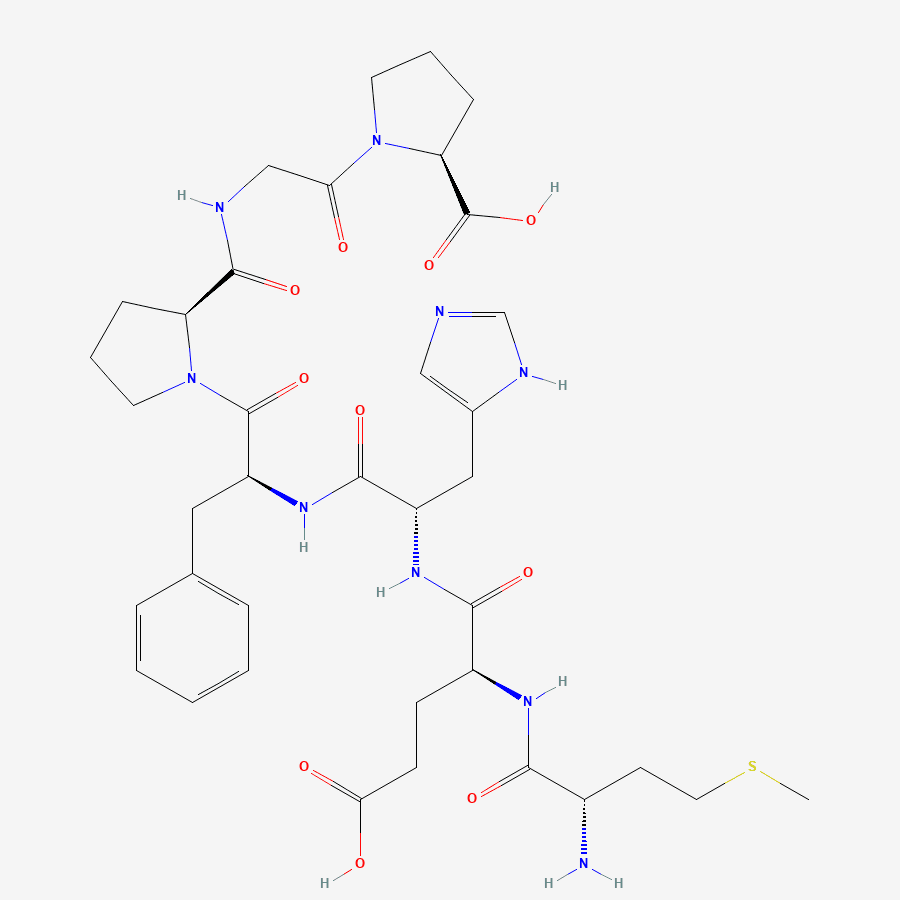
This is a lab-made substance approved as a prescription nasal spray in Russia for stroke recovery and brain fog. Outside Russia, it's sold as an unregulated 'brain booster' without the same quality controls.
- What it is
- A synthetic ACTH(4-10) fragment, approved and sold as a prescription nasal spray in Russia for post-stroke and cognitive indications — not approved as a medicine in the US, UK or EU.
- Evidence
- Multiple Russian clinical trials, some RCT-labeled, report functional benefit after ischemic stroke and in cerebrovascular insufficiency. None has been independently replicated outside Russia or reviewed by a Western regulator.
- Studied dose
- Stroke trials used 6–18 mg/day intranasally over 5–10 day courses — far higher than the microgram doses typically sold online for 'nootropic' use, which have no trial support at all.
- Safety
- Described as well tolerated with a low rate of side effects in the Russian trials that reported on it, but that characterization has never been reviewed by a Western regulatory safety process.
What human trials actually show
Randomized, placebo-controlled human trials only. Animal data never appears in this section — it cannot raise a grade, and it is noted separately below.
- 01Zhurnal nevrologii i psikhiatrii imeni S.S. Korsakova2018— Post-stroke rehabilitation, BDNF and functional recovery
- Design
- Clinical trial, early vs. late rehabilitation groups, semax vs. no-semax subgroups
- Dose
- 6,000 mcg/day intranasally, two 10-day courses with a 20-day interval
- Duration
- Assessed across early (~89 days) and late (~214 days) rehabilitation windows
110 patients following ischemic stroke (43 men, 67 women, mean age 58)
Semax administration raised plasma BDNF levels regardless of rehabilitation timing, and higher BDNF was associated with faster and better final Barthel index (functional independence) scores. Early rehabilitation plus semax produced the best outcomes.
doi:10.17116/jnevro20181183261-68 - 02Doklady Biological Sciences2020— Brain functional connectivity (fMRI)
- Design
- Placebo-controlled, resting-state fMRI before and after dosing
- Dose
- Single dose, compared against Selank and placebo
- Duration
- Scanned before, and 5 and 20 minutes after administration
52 healthy participants
Semax produced measurable changes in resting-state functional connectivity between the right amygdala and right temporal cortex, distinguishable from both placebo and Selank's effects. This shows a real, placebo-controlled acute brain effect in healthy humans, but it is a connectivity signal, not a clinical outcome.
doi:10.1134/S001249662001007X
The largest gap is independence: essentially every human trial on Semax comes from a small, overlapping set of Russian institutes connected to the compound's own development, and none has been replicated by an outside lab in or outside Russia. The pivotal 1997 dose-finding stroke trial (Gusev et al., PMID 11517472) — which set the widely cited 12–18 mg/day protocol — has no assigned DOI and limited methodological detail available in its abstract. A 2007 trial in motor neuron disease was explicitly open-label. No study has used a validated, blinded, placebo-controlled design against the exact low microgram doses sold online for cognitive enhancement — the clinical trials that exist all used medical-grade doses for stroke and neurological disease, not the 'nootropic' use case it is marketed for. Human pharmacokinetics, especially after chronic intranasal dosing at home rather than in a clinic, are not well characterized.
Grade C — early. Real, RCT-labeled Russian trials report functional outcomes — Barthel index recovery, motor performance, quality of life — in several hundred patients combined. But every trial traces back to an overlapping set of Moscow-based institutes involved in the drug's own development, none has been independently replicated outside Russia, blinding is inconsistent or absent in several (one key motor-neuron-disease trial is explicitly open-label), and neither the FDA nor the EMA has reviewed the compound. That is a materially different evidence tier from an approved drug, even though the underlying trials are real. How we grade evidence.
Side effects & safety
- Reported in Russian trials
- A 2005 trial in 187 patients with cerebrovascular insufficiency described Semax as featuring 'a minor percent of side-effects' and being well tolerated, including in older patients. No detailed adverse-event breakdown from a Western-standard safety review exists.
- Product risk
- Nasal sprays sold outside Russia are not manufactured under any pharmaceutical quality system reviewed by a Western regulator. Purity, sterility, and actual peptide content are unverified for anything bought online.
- The honest caveat
- "Well tolerated" in these trials reflects assessment inside a Russian clinical and regulatory system that approved the drug on its own evidence; it has not been independently verified by FDA, EMA or any equivalent Western pharmacovigilance process.
Interactions with medications
The section most longevity sites skip. If you take prescription medication, read this before anything else on the page.
No controlled human interaction studies exist outside the Russian trial programme, and none of those specifically tested drug-drug interactions.
Semax is derived from ACTH, and its interaction with corticosteroids, other HPA-axis-active drugs, or hormone therapy has not been studied in humans.
Semax is not explicitly named on the current WADA Prohibited List the way some other research peptides are, but ACTH and ACTH-releasing peptides as a class fall under WADA's S2 peptide-hormone category. Tested athletes should treat this as high-risk and confirm status with their anti-doping authority rather than assume it is exempt.
Is Semax legal where you live?
Regulatory status is tracked per market and reviewed on the date shown. Where a compound is not authorised, this site does not link to sellers.
Semax is approved and sold as a prescription nasal spray in Russia for post-stroke and cognitive indications, but that domestic Russian approval carries no legal weight in the United States. The FDA has not reviewed or approved Semax for any use, and it is not lawfully marketed as a dietary supplement.
Source: US Food and Drug Administration
No UK marketing authorisation as a medicine, and no permitted route to sell it as a food supplement. Its Russian prescription status has no standing under UK law.
Source: MHRA
No EU marketing authorisation and no novel-food authorisation. The EMA has not reviewed Semax, and its Russian approval does not extend to the EU.
Source: European Medicines Agency
Germany applies the EU position: no authorised medicinal product and no permitted supplement use, regardless of Russian prescription status.
Source: BfArM / European Medicines Agency
Aucune autorisation de mise sur le marché dans l'UE et aucun statut de nouvel aliment. Le statut de médicament sur ordonnance en Russie n'a aucune valeur juridique en France.
Source: European Commission / ANSM
Sin autorización de comercialización en la UE ni condición de nuevo alimento. Su estatus de medicamento con receta en Rusia no tiene validez legal en España.
Source: Comisión Europea / AEMPS
Dosing & timing
Russian trials for ischemic stroke and cerebrovascular disease used 6 mg/day (10-day courses) up to 12–18 mg/day for moderate-to-severe stroke, under clinical supervision.
Doses sold and discussed online for cognitive enhancement are far lower than any studied clinical dose and have no trial data behind them at all — this is an extrapolation, not a tested protocol.
Every published human study used an intranasal solution or drops. There is no human data on oral, injectable, or other delivery routes.
Questions people actually ask
Is Semax the same thing as "XA10" or "XA-11"?
Possibly, but not reliably. At least one vendor sells Semax under the code XA10; another uses XA-11 for the same compound. These vendor-specific dose/batch codes are not standardized across sellers, so a code alone is not a reliable way to confirm what's actually in a vial — check the vendor's own product listing for the compound name, not just the code.
Is Semax legal in the United States?
It is not an approved drug and is not lawfully marketed as a dietary supplement in the US. The FDA has not reviewed Semax for any indication, and there is no lawful commercial route to sell it here.
What does the human evidence actually show?
Real Russian trials — some RCT-labeled — report improved stroke rehabilitation measures (Barthel index, motor recovery, BDNF levels) and other neurological benefits in several hundred patients combined. That is genuine, published, PubMed-indexed evidence. It has just never been independently replicated outside Russia or reviewed by a Western drug regulator, which is a real limitation, not a technicality.
Why is Semax approved in Russia but not in the US or EU?
Russia's regulatory system accepted a domestic clinical trial programme as sufficient for approval. The FDA and EMA use a different, independently verified evidentiary bar — including replication, blinding standards, and manufacturing oversight — that Semax's existing trial record has not been put through. Approval in one country's system does not transfer to another's.
Is Semax the same as Selank?
No. Both are short Russian-developed peptides studied at the same institutes and sometimes tested side by side (as in one placebo-controlled fMRI study), but they are structurally different compounds marketed for different uses — Semax for cognitive/neurological effects, Selank as an anxiolytic.
Is it safe to use a Semax nasal spray bought online?
Unknown. Published trials describe it as well tolerated at clinical doses under Russian medical supervision, but that says nothing about an unregulated product of unverified purity, self-administered at an unstudied dose, outside any clinical monitoring.